

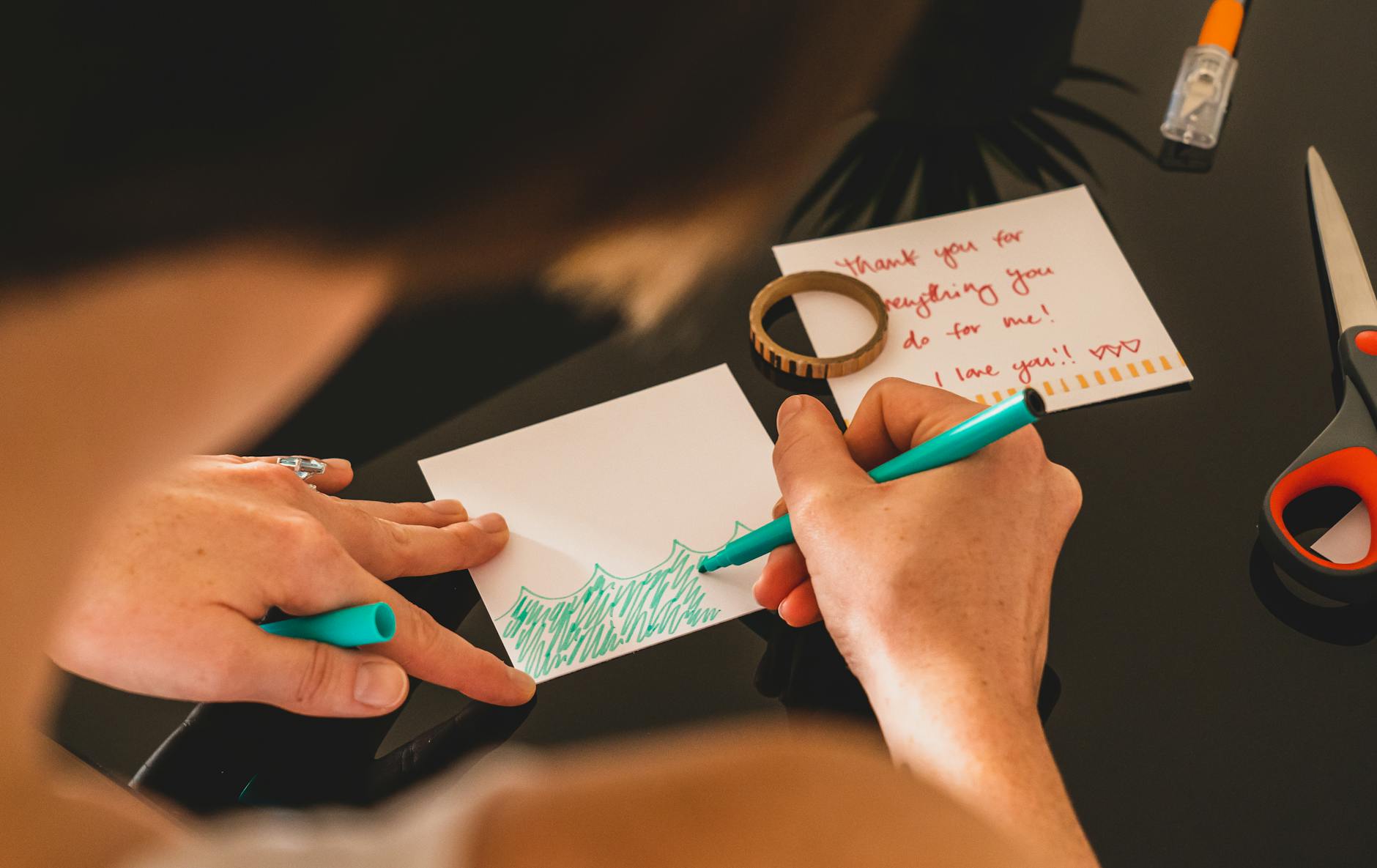
There’s something quietly powerful about a stack of 3×5 note cards.
Not flashy. Not digital. Not overwhelming.
Just… clear.
If you’ve ever felt lost in your own story—buried in chapter details, tangled in scenes, unsure where your character is even going anymore—you’re not alone. Most writers don’t struggle because they lack ideas. They struggle because their ideas don’t have a structure they can see and hold.
That’s where note cards come in.

Why Note cards Work (When Your Brain Feels Full)
A novel is big. Emotionally big. Structurally big.
Trying to hold all of it in your head—or even in a single document—can feel like trying to organize a storm.
Note cards break the storm into pieces.
Each card becomes one small, manageable truth:
- A moment
- A decision
- A turning point
- A realization
Instead of writing your story in order and getting stuck in perfectionism, you build your story like a map.
The Note card Method (Simple, Clean, Focused)
Here’s a way to structure your deck without over-complicating it:
1. Start with the Spine of Your Story
Before anything else, write 5–10 core cards:
- Opening situation
- Inciting incident
- First major decision
- Midpoint shift
- Lowest moment
- Final push
- Resolution
That’s it. No fluff. No details.
Just the bones.
If you don’t know these yet, that’s okay—but you need a direction, not perfection.
2. One Scene Per Card
Now begin expanding.
Each card should answer:
- What happens?
- Why does it matter?
- How does it move the protagonist forward?
Keep it short. A few lines max.
You are not writing the chapter—you are capturing the purpose of the chapter.
3. Track Your Protagonist’s Drive
This is where most writers drift.
Every few cards, ask:
- What does she want right now?
- What’s pushing her forward?
- What’s getting in her way?
If you can’t answer that clearly, the story will feel flat—no matter how beautiful your writing is.
Your protagonist isn’t just moving through events.
She’s choosing.
How This Prevents You from Getting Stuck
Here’s the truth most writers don’t want to hear:
Getting lost in chapter details often feels productive—but it’s usually avoidance.
It’s safer to describe a room than decide what your character risks.
Note cards keep you honest.
They gently force you to focus on:
- Movement
- Conflict
- Direction
Instead of:
- Overwriting
- Perfect sentences
- Endless revisions
You’re building momentum first, polish later.
Knowing Where Your Story Is Going
You don’t need every detail figured out.
But you do need:
- A sense of the ending
- A clear emotional arc
- A reason your protagonist keeps going
Ask yourself:
Why doesn’t she quit?
That answer is your story’s heartbeat.
Write it on a card. Keep it visible.
Because when you get tired (and you will), that’s the card that pulls you back.
First Person vs Third Person — What Changes?
This is one of those choices that quietly shapes everything.
Let’s make it simple:
First Person (I, me, my)
Feels like:
- A journal
- A confession
- A close, emotional lens
Best for:
- Deep internal struggle
- Personal transformation
- Strong voice-driven stories
Your reader lives inside her mind.
Every thought, every doubt, every shift feels immediate.
But here’s the trade-off:
You only see what she sees.
Third Person (she, her)
Feels like:
- A wider world
- A bit more breathing room
- Slight emotional distance
Best for:
- Multiple characters
- Expansive settings
- Layered story lines
You can zoom in and out.
You can show things your protagonist doesn’t fully understand yet.
But the emotional intensity is a little softer unless you write very close third person.
So… Which Should You Choose?
Ask yourself:
- Is this story about what she feels or what happens to her?
- Do I want the reader inside her, or watching her?
If your story is deeply personal and character-driven → lean first person
If your story is broader, with movement and multiple layers → lean third person
There’s no “better.”
There’s only what serves this story.
A Gentle Truth About Discouragement
You will get discouraged.
Not because you’re doing it wrong—but because writing asks you to sit in uncertainty.
Some days:
- The story feels flat
- The cards feel messy
- The direction feels unclear
That doesn’t mean you’ve failed.
It means you’re in the middle.
And the middle is always the hardest place to see clearly.
What to Do When You Feel Stuck
Go back to your cards.
Not your chapters. Not your sentences.
Your cards.
Ask:
- Where was she last moving forward?
- What changed?
- What decision comes next?
Then write one more card.
Not ten. Not a whole chapter.
Just one.
Momentum doesn’t come from intensity.
It comes from continuation.
You Are Building Something Real
Every card you write is proof:
- You showed up
- You made a decision
- You moved the story forward
Even when it feels small.
Even when it feels unfinished.
Stories aren’t written in perfect bursts of inspiration.
They’re built—quietly, steadily—card by card.
Final Thought
You don’t need to have everything figured out to keep going.
You just need:
- A direction
- A character who wants something
- The willingness to write the next step
So take a card.
Write one moment.
And trust that it counts.
Leave a Reply